Karnataka to Introduce STEAM Education in State Public Schools
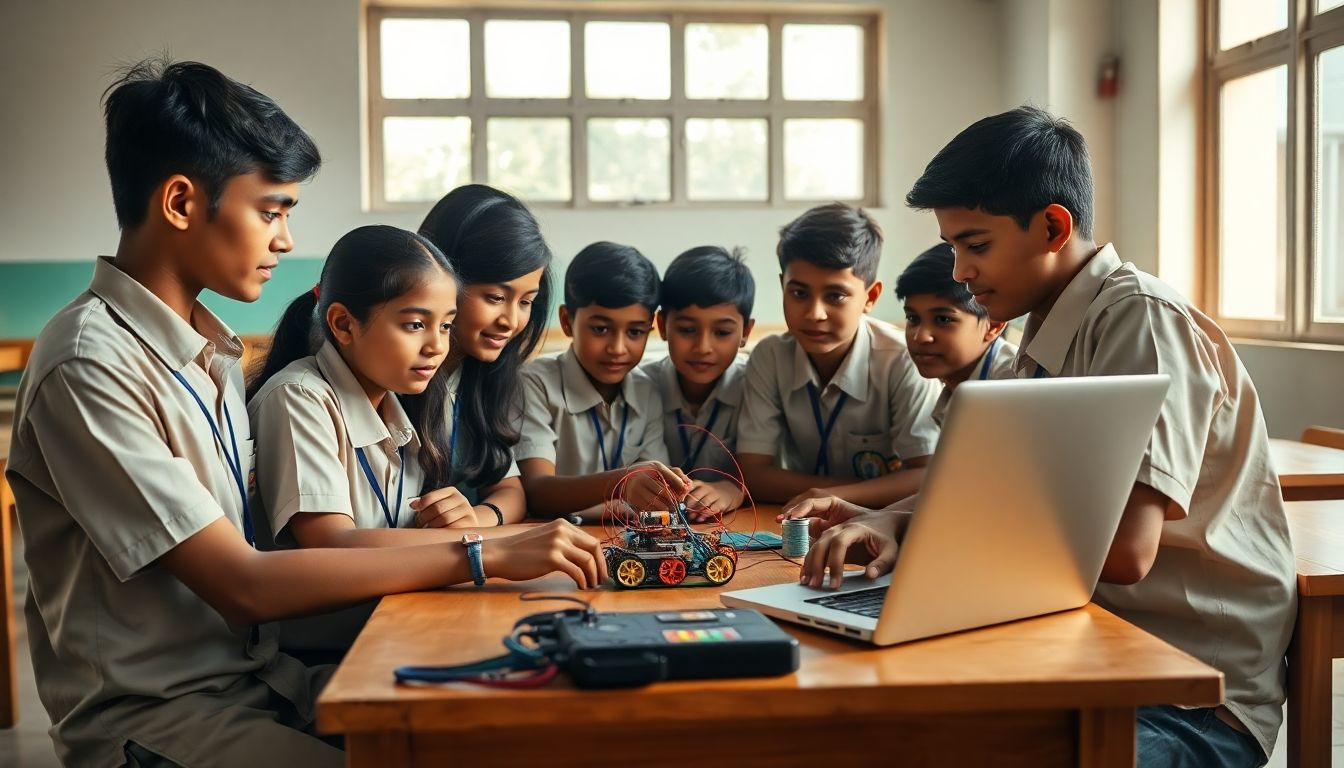
The Karnataka State Government has decided to introduce STEAM-based high-tech education for students in Karnataka Public Schools (KPS), starting at the high school level. Announced on June 27, 2026, the initiative by the Department of School Education and Literacy (DSEL) aims to shift the state's school education from traditional rote-learning to hands-on, project-based learning.
STEAM, which stands for Science, Technology, Engineering, Arts, and Mathematics, focuses on making learning more engaging through experiments, robotics, coding, electronics, model building, and practical problem-solving.
In contrast to the traditional model where students primarily read textbooks and write exams, the STEAM framework emphasizes developing skills to solve real-life problems.
According to a DSEL official, the new curriculum is designed to prepare students for future careers and foster creative entrepreneurship. "STEAM will encourage students to become creative and work collaboratively in a team," the official said. "The inclusion of ‘Arts’ in STEAM will enhance the imagination of students, help them with design thinking, and enable them to find creative and innovative solutions."
The official added that technical knowledge alone will not be sufficient in the future job market. Students will also require design skills, teamwork, communication, and new ideas. The STEAM curriculum is intended to provide foundational skills for emerging sectors such as artificial intelligence (AI), machine learning, cybersecurity, data science, and space technology.
A pilot version of this program, focusing on robotics, coding, AI, and practical learning, is already underway at the KPS in Kalasa, Chikkamagaluru district, supported by the Atal Tinkering Lab (ATL). Following this pilot, the government plans to focus on STEAM-based modules across all Karnataka Public Schools.
Vikas Kishor Suralkar, the Commissioner for School Education, confirmed that the department is currently taking measures to make the necessary curriculum changes to implement the system. "This will help students develop the skills required for the future job market," Suralkar noted.